Category: Blogs & Insights

  • Restorative Design Engineering Approach

    Restorative Design Engineering Approach

    Today’s consumer goods industry demands packaging solutions that go far beyond product containment. Modern packaging is expected to deliver sustainability, operational efficiency, shelf differentiation, material optimization, recyclability, and cost competitiveness — all while maintaining high standards of quality and performance. 

    Global brands and retailers are increasingly looking for packaging partners that can help them achieve ambitious ESG goals, circular economy commitments, lightweighting targets, and sustainable packaging transformation. 

    At Alternicq Limited, we believe the future of packaging lies in restorative design engineering — a strategic approach that combines sustainability, material science, packaging innovation, and lifecycle optimization to create next-generation rigid plastic packaging solutions. 

    Why Sustainable Packaging Design Matters 

    Plastic packaging continues to play a vital role in modern supply chains due to its: 

    • Lightweight properties  
    • High durability  
    • Barrier protection capabilities  
    • Transportation efficiency  
    • Design flexibility  
    • Recyclability potential  
    • Lower overall lifecycle emissions  

    In India, packaging accounts for a significant share of plastic consumption, making packaging redesign and circular design engineering critical to reducing environmental impact. 

    Sustainable packaging innovation today focuses on: 

    • Material reduction  
    • Design-for-recyclability  
    • Lightweighting  
    • PCR integration  
    • Improved reuse systems  
    • End-of-life optimization  
    • Circular packaging ecosystems  

    Even small improvements in packaging weight, structure, and recyclability can create substantial reductions in carbon emissions, material usage, and supply chain waste. 

    Our Restorative Design Engineering Philosophy 

    At Alternicq Limited, we collaborate with FMCG, food and beverage, dairy, pharmaceutical, home care, and personal care brands to redesign packaging for improved sustainability and business performance. 

    Our restorative design engineering framework focuses on: 

    • Sustainable material optimization  
    • Product lifecycle enhancement  
    • Lightweight packaging innovation  
    • Packaging functionality improvement  
    • Operational efficiency  
    • Circular economy integration  

    Over the years, several redesign initiatives have enabled up to 20% reduction in plastic usage per package while maintaining packaging integrity and shelf performance.  

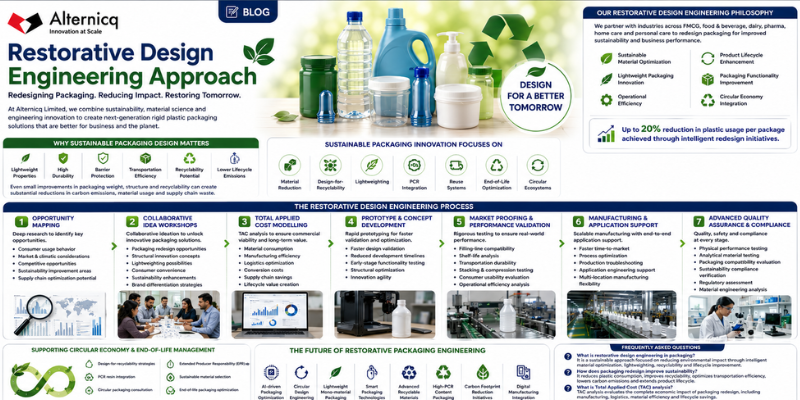
    The Restorative Design Engineering Process 

    1. Opportunity Mapping 

    Every sustainable packaging project begins with deep design and material research. 

    This stage focuses on identifying: 

    • Consumer usage behavior  
    • Market-specific packaging needs  
    • Geographic and climatic considerations  
    • Competitive differentiation opportunities  
    • Sustainability improvement areas  
    • Supply chain optimization potential  

    Opportunity mapping helps identify how packaging redesign can improve both environmental and commercial outcomes. 

    2. Collaborative Idea Workshops 

    Innovation is strongest when packaging engineers, designers, and brand teams collaborate closely. 

    Our ideation workshops focus on: 

    • Packaging redesign opportunities  
    • Structural innovation concepts  
    • Lightweighting possibilities  
    • Consumer convenience improvements  
    • Sustainability enhancements  
    • Brand differentiation strategies  

    At this stage, multiple packaging concepts and design directions are explored to create differentiated and scalable packaging solutions. 

    3. Total Applied Cost Modelling 

    Sustainable packaging must also make commercial sense. 

    Our Total Applied Cost (TAC) analysis evaluates: 

    • Material consumption  
    • Manufacturing efficiency  
    • Logistics optimization  
    • Conversion costs  
    • Supply chain savings  
    • Lifecycle value creation  

    This approach helps brands understand the long-term economic benefits of sustainable packaging redesign. 

    4. Prototype and Concept Development 

    Using advanced prototyping technologies and 3D printing systems, packaging concepts are rapidly converted into functional prototypes. 

    This stage enables: 

    • Faster design validation  
    • Reduced development timelines  
    • Improved innovation agility  
    • Early-stage functionality testing  
    • Structural optimization  

    Rapid prototyping helps accelerate packaging innovation while minimizing production disruption. 

    5. Market Proofing and Performance Validation 

    Before commercialization, packaging solutions undergo extensive validation studies. 

    These include: 

    • Filling-line compatibility testing  
    • Shelf-life analysis  
    • Transportation durability assessment  
    • Stacking and compression testing  
    • Consumer usability evaluation  
    • Operational efficiency analysis  

    Market proofing ensures packaging performs consistently across real-world supply chain conditions. 

    6. Manufacturing and Application Support 

    With large-scale manufacturing capabilities and advanced converting infrastructure, Alternicq Limited supports rapid commercialization and optimized production scalability. 

    Our manufacturing support includes: 

    • Faster time-to-market  
    • Process optimization  
    • Production troubleshooting  
    • Application engineering support  
    • Multi-location manufacturing flexibility  

    Efficient converting systems are essential for scaling sustainable packaging innovation successfully. 

    7. Advanced Quality Assurance and Compliance 

    High-performance sustainable packaging requires rigorous testing and compliance management. 

    Our quality assurance framework includes: 

    • Physical performance testing  
    • Analytical material testing  
    • Packaging compatibility evaluation  
    • Sustainability compliance verification  
    • Regulatory assessment  
    • Material engineering analysis  

    Dedicated QA specialists, chemists, and material engineers help ensure packaging consistency, safety, and operational reliability. 

    Supporting Circular Economy and End-of-Life Management 

    Sustainable packaging design must also consider what happens after product usage. 

    At Alternicq Limited, we support customers through: 

    • Design-for-recyclability strategies  
    • PCR resin integration  
    • Circular packaging consultation  
    • Extended Producer Responsibility (EPR) support  
    • Sustainable material selection  
    • End-of-life packaging optimization  

    Our sustainability specialists help brands navigate evolving global regulations, emerging sustainability standards, and circular economy frameworks. 

    The Future of Restorative Packaging Engineering 

    The future of sustainable packaging will increasingly be shaped by: 

    • AI-driven packaging optimization  
    • Circular design engineering  
    • Lightweight mono-material packaging  
    • Smart packaging technologies  
    • Advanced recyclable barrier materials  
    • High-PCR-content packaging  
    • Carbon footprint reduction initiatives  
    • Digital manufacturing integration  

    Packaging design is no longer just about aesthetics or functionality — it is becoming a strategic sustainability and business transformation tool. 

    At Alternicq Limited, restorative design engineering continues to drive innovation across rigid plastic packaging ecosystems, helping brands build scalable, sustainable, and future-ready packaging solutions. 

    Frequently Asked Questions 

    What is restorative design engineering in packaging? 

    Restorative design engineering is a sustainable packaging approach focused on reducing environmental impact through intelligent material optimization, lightweighting, recyclability, and lifecycle improvement. 

    How does packaging redesign improve sustainability? 

    Packaging redesign can reduce plastic consumption, improve recyclability, optimize transportation efficiency, lower carbon emissions, and extend product lifecycle. 

    What is Total Applied Cost (TAC) analysis? 

    TAC analysis evaluates the complete economic impact of packaging redesign, including manufacturing, logistics, material efficiency, and lifecycle savings. 

    Why is rapid prototyping important in packaging innovation? 

    Rapid prototyping accelerates packaging development, improves design validation, and reduces commercialization timelines through early-stage testing and optimization. 

    How does Alternicq support circular packaging initiatives? 

    Alternicq Limited supports circular packaging through lightweighting, recyclable packaging design, PCR integration, EPR support, sustainable material innovation, and end-of-life packaging optimization.
  • Design Thinking for Plastic Waste Reduction

    Design Thinking for Plastic Waste Reduction

    Plastic remains one of the most efficient and versatile packaging materials used across industries today. From food and beverages to healthcare, personal care, dairy, home care, and industrial applications, plastic packaging plays a critical role in product protection, transportation efficiency, hygiene, durability, and shelf-life enhancement. 

    However, the global conversation around sustainability has shifted the focus from plastic usage itself to how plastics are designed, used, recovered, and recycled within a circular economy framework. 

    At Alternicq Limited, we believe the future of sustainable packaging lies in intelligent design thinking, material optimization, recyclability, lightweighting, and responsible end-of-life management. 

    Understanding the Sustainability Advantage of Plastic Packaging 

    Despite widespread misconceptions, multiple lifecycle assessments (LCA) indicate that plastic packaging often has a lower environmental footprint compared to alternative materials when evaluated across the entire supply chain. 

    Plastic packaging offers several sustainability advantages: 

    • Lower transportation emissions due to lightweight structures  
    • Reduced energy consumption during manufacturing  
    • Lower water usage compared to many alternative materials  
    • Reduced food wastage through superior barrier performance  
    • Lower greenhouse gas emissions across logistics operations  
    • Higher durability and product protection efficiency  

    The unique combination of: 

    • Lightweight properties  
    • Flexibility  
    • Barrier protection  
    • Durability  
    • Design adaptability  
    • Reusability potential  

    makes plastic packaging highly efficient for modern supply chains. 

    The real sustainability challenge lies not in the material itself, but in improving circularity, recyclability, reuse systems, and post-consumer waste management. 

    Building a Circular Economy Through Packaging Innovation 

    At Alternicq Limited, sustainability innovation is focused on enabling a circular plastics economy through: 

    • Design-for-recyclability  
    • Lightweight packaging solutions  
    • Post-consumer recycled (PCR) integration  
    • Reusable packaging systems  
    • Material reduction initiatives  
    • Packaging redesign optimization  
    • Advanced recycling and recovery support  

    We believe sustainable packaging begins at the design stage. 

    Design Thinking for Product Life Improvement 

    Design thinking in packaging is a user-centric innovation approach that focuses on improving packaging functionality, extending product lifecycle, reducing waste, and enhancing sustainability outcomes. 

    This process involves redesigning packaging structures to: 

    • Reduce unnecessary material usage  
    • Improve product durability  
    • Increase reusability  
    • Enhance recyclability  
    • Improve transportation efficiency  
    • Extend packaging lifecycle  

    Our packaging engineering approach focuses on two primary areas: 

    1. Plastic Reduction Through Lightweighting 

    Reducing resin consumption through structural optimization and advanced engineering. 

    2. Product Life Extension Through Better Design 

    Designing packaging that survives multiple usage cycles and reduces landfill waste. 

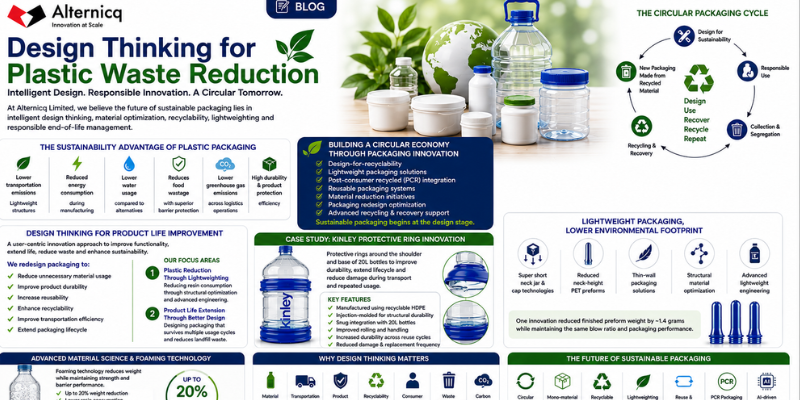
    Case Study: The Kinley Protective Ring Innovation 

    One of the most impactful examples of sustainable packaging redesign is the protective ring developed in collaboration with Kinley for 20-liter water bottles.  

    The objective was to: 

    • Improve bottle durability  
    • Extend product lifecycle  
    • Reduce deformation during transportation  
    • Improve handling efficiency across repeated usage cycles  

    The solution involved designing protective rings around the shoulder and base of the bottle. 

    Key Features of the Protective Ring Design 

    • Manufactured using recyclable HDPE material  
    • Injection-molded for structural durability  
    • Designed for snug integration with 20-liter bottles  
    • Improved rolling and handling during logistics operations  
    • Increased bottle durability across multiple reuse cycles  
    • Reduced packaging damage and replacement frequency  

    The design not only improved operational performance but also supported circular packaging objectives by extending the reusable lifecycle of large-format water containers. 

    Lightweight Packaging for a Lower Environmental Footprint 

    Lightweighting is one of the most effective strategies for reducing plastic consumption while maintaining packaging performance. 

    At Alternicq Limited, lightweight packaging innovation includes: 

    • Super short neck jar and cap technologies  
    • Reduced neck-height PET preforms  
    • Thin-wall packaging solutions  
    • Structural material optimization  
    • Advanced lightweight container engineering  

    One of our lightweight preform innovations reduced finished preform weight by approximately 1.4 grams while maintaining the same blow ratio and packaging performance.  

    Advanced Material Science and Foaming Technology 

    Modern material science is creating new opportunities for sustainable rigid plastic packaging. 

    One such innovation is foaming technology, which enables the reduction of packaging weight while maintaining mechanical strength and barrier performance. 

    Foaming technology can: 

    • Reduce container weight by up to 20%  
    • Lower resin consumption  
    • Reduce transportation emissions  
    • Maintain tensile strength  
    • Preserve barrier properties  

    These innovations help brands reduce overall environmental footprint while maintaining operational efficiency and product safety. 

    Why Design Thinking Matters in Sustainable Packaging 

    Packaging design directly impacts: 

    • Material consumption  
    • Transportation efficiency  
    • Product protection  
    • Recyclability  
    • Consumer usability  
    • Waste generation  
    • Carbon footprint  

    Smart packaging design enables companies to move beyond compliance and toward measurable sustainability transformation. 

    Modern sustainable packaging strategies increasingly focus on: 

    • Circular economy integration  
    • Mono-material packaging  
    • Recyclable rigid packaging  
    • Lightweighting technologies  
    • Reuse and refill systems  
    • PCR packaging adoption  
    • AI-driven packaging optimization  

    The Future of Sustainable Plastic Packaging 

    The future of plastic packaging lies in combining: 

    • Sustainable material innovation  
    • Intelligent structural engineering  
    • Circular packaging ecosystems  
    • High-performance recyclability  
    • Lightweighting technologies  
    • Advanced recovery systems  

    As industries move toward net-zero goals and circular economy frameworks, packaging design will play a decisive role in reducing environmental impact at scale. 

    At Alternicq Limited, we continue to innovate sustainable rigid plastic packaging solutions that balance performance, scalability, recyclability, and long-term environmental responsibility. 

    Frequently Asked Questions 

    What is design thinking in sustainable packaging? 

    Design thinking in packaging refers to a user-centric approach focused on improving packaging functionality, reducing waste, enhancing recyclability, and extending product lifecycle. 

    How does lightweight packaging reduce environmental impact? 

    Lightweight packaging reduces resin consumption, lowers transportation emissions, improves logistics efficiency, and minimizes overall carbon footprint. 

    What is foaming technology in plastic packaging? 

    Foaming technology involves infusing inert gases into plastic materials to reduce density and weight while maintaining structural strength and barrier properties. 

    Why is reusable packaging important? 

    Reusable packaging extends the lifecycle of packaging materials, reduces waste generation, and supports circular economy objectives. 

    How is Alternicq contributing to sustainable packaging innovation? 

    Alternicq Limited develops sustainable rigid plastic packaging solutions focused on lightweighting, recyclability, PCR integration, packaging redesign, and circular economy innovation across multiple industries.

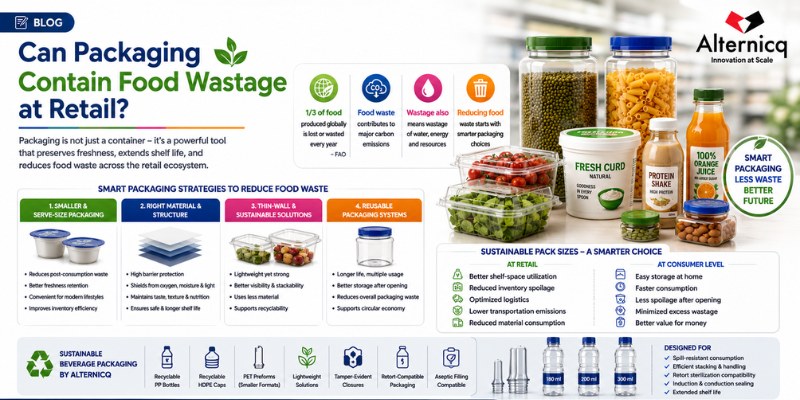
  • Can Packaging Contain Food Wastage at Retail?

    Can Packaging Contain Food Wastage at Retail?

    Food loss and food waste have become critical global sustainability challenges. According to estimates by the Food and Agriculture Organization (FAO) of the United Nations, nearly one-third of all food produced for human consumption is lost or wasted globally each year — amounting to approximately 1.3 billion tonnes annually. This contributes significantly to carbon emissions, water wastage, and supply chain inefficiencies. 

    As sustainability, circular economy practices, and responsible consumption gain importance, packaging is increasingly being recognized as a critical enabler in reducing food wastage across the retail and consumer ecosystem. 

    At Alternicq Limited, we believe packaging innovation plays a vital role in improving shelf life, reducing spoilage, enabling efficient storage, and supporting sustainable food distribution systems. 

    Understanding Food Waste at Retail 

    Food wastage at the retail stage is driven by multiple factors, including: 

    • Poor packaging performance  
    • Inadequate barrier protection  
    • Improper temperature management  
    • Transportation damage  
    • Exposure to oxygen and moisture  
    • Inaccurate pack sizing  
    • Improper storage after opening  
    • Limited consumer awareness of shelf-life handling  

    Studies indicate that food wastage levels across supply chains can range between 24% and 40%, making packaging optimization a major opportunity area for brands, retailers, and manufacturers.  

    Modern sustainable packaging must therefore do more than simply contain a product — it must actively preserve freshness, improve usability, optimize storage, and reduce environmental impact. 

    The Role of Sustainable Packaging in Reducing Food Waste 

    Advanced packaging technologies can significantly improve food preservation and reduce losses at both retail and consumer levels. 

    Effective food packaging solutions help: 

    • Extend shelf life  
    • Maintain freshness and taste  
    • Improve moisture and oxygen protection  
    • Reduce contamination risks  
    • Enable efficient transportation  
    • Improve storage convenience  
    • Minimize post-opening spoilage  

    Packaging design today increasingly combines: 

    • High-barrier packaging materials  
    • Recyclable rigid packaging  
    • Lightweight packaging  
    • Reusable packaging formats  
    • Sustainable pack-size optimization  
    • Active and modified atmosphere packaging technologies  

    1. Introduce Smaller and Serve-Size Packaging 

    Single-serve and portion-controlled packaging formats are becoming increasingly important in reducing food wastage. 

    Smaller packaging formats offer several advantages: 

    • Reduced post-consumption waste  
    • Improved freshness retention  
    • Easier inventory management  
    • Better stock efficiency at retail  
    • Enhanced convenience for consumers  
    • Lower storage requirements  

    Serve-size packaging also supports evolving urban consumption patterns where consumers increasingly prefer convenience, portability, and controlled consumption. 

    For products with shorter post-opening shelf life — such as dairy products, juices, frozen foods, and ready-to-drink beverages — smaller pack sizes can significantly reduce wastage. 

    2. Choose the Right Packaging Material and Structure 

    Every food product has unique storage and preservation requirements. 

    Packaging material selection must consider: 

    • Oxygen barrier requirements  
    • Moisture sensitivity  
    • Light protection  
    • Temperature stability  
    • Transportation durability  
    • Product compatibility  

    High-performance packaging structures help maintain freshness across the product’s journey from manufacturing to retail shelf. 

    Advanced barrier materials such as: 

    • Polypropylene (PP)  
    • High-Density Polyethylene (HDPE)  
    • PET  
    • EVOH-based multilayer structures  

    are increasingly used to improve food preservation and reduce spoilage. 

    Customized rigid packaging solutions also help ensure product integrity during handling, storage, and transportation. 

    3. Adopt Thin-Wall and Sustainable Packaging Solutions 

    Retail-ready fresh produce such as cut fruits, vegetables, and bakery products require packaging that balances convenience with preservation. 

    Thin-wall rigid containers offer: 

    • Improved product visibility  
    • Better storage efficiency  
    • Lightweight sustainability benefits  
    • Enhanced stackability  
    • Improved product protection  

    Sustainable thin-wall packaging formats can also support recyclability and circular packaging initiatives while reducing overall material consumption. 

    4. Encourage Reusable Packaging Systems 

    Reusable packaging plays a significant role in sustainable food packaging ecosystems. 

    Rigid plastic packaging often has a longer usable lifecycle compared to flexible packaging formats, making it ideal for reuse applications. 

    Reusable packaging benefits include: 

    • Extended packaging lifecycle  
    • Reduced packaging waste  
    • Improved household storage  
    • Better protection after opening  
    • Lower overall environmental impact  

    Consumers increasingly prefer packaging formats that offer secondary usability and long-term utility beyond the primary product application. 

    Sustainable Pack Sizes: A Smarter Packaging Strategy 

    Optimized pack sizing is emerging as one of the most practical approaches to reducing food wastage. 

    Smaller and sustainable pack sizes help: 

    At Retail 

    • Improve shelf-space utilization  
    • Reduce inventory spoilage  
    • Optimize logistics efficiency  
    • Lower transportation emissions  
    • Reduce material consumption  

    At Consumer Level 

    • Improve storage convenience  
    • Enable faster consumption  
    • Reduce spoilage after opening  
    • Minimize excess product wastage  

    Pack-size optimization also supports brands in achieving sustainability targets while improving affordability and accessibility. 

    Sustainable Beverage Packaging Innovations 

    At Alternicq Limited, we continue to innovate in sustainable rigid plastic packaging for the beverage and food industry. 

    Our packaging portfolio includes: 

    • Recyclable PP bottles  
    • Recyclable HDPE caps  
    • PET preforms for smaller beverage formats  
    • Lightweight packaging solutions  
    • Tamper-evident closures  
    • Retort-compatible packaging systems  

    We manufacture packaging solutions in multiple fill volumes including: 

    • 180 ml  
    • 200 ml  
    • 300 ml  

    These packaging solutions are designed for: 

    • Spill-resistant consumption  
    • Efficient stacking and handling  
    • Retort sterilization compatibility  
    • Induction and conduction sealing  
    • Extended shelf life applications  

    Our PET beverage packaging solutions are also compatible with aseptic filling environments and advanced food safety requirements. 

    The Future of Sustainable Food Packaging 

    The future of food packaging will increasingly focus on: 

    • Circular packaging systems  
    • Recyclable mono-material packaging  
    • Smart packaging technologies  
    • Lightweight packaging  
    • Reusable packaging ecosystems  
    • PCR-integrated food packaging  
    • AI-driven packaging optimization  
    • Shelf-life extension technologies  

    As food security and sustainability become global priorities, packaging innovation will continue to play a central role in reducing food waste across the value chain. 

    Frequently Asked Questions 

    How does packaging reduce food waste? 

    Packaging reduces food waste by protecting products from oxygen, moisture, contamination, transportation damage, and spoilage while improving shelf life and storage efficiency. 

    Why are smaller pack sizes important? 

    Smaller pack sizes reduce post-opening spoilage, improve consumption efficiency, and minimize product wastage at both retail and household levels. 

    What packaging materials are best for food preservation? 

    Materials such as PET, PP, HDPE, and EVOH-based multilayer structures offer strong barrier properties that help preserve freshness and extend shelf life. 

    Is reusable rigid packaging more sustainable? 

    Yes. Reusable rigid packaging extends packaging lifecycle, improves storage usability, and reduces overall packaging waste when integrated effectively into circular economy systems. 

    How is Alternicq contributing to sustainable food packaging? 

    Alternicq Limited develops advanced rigid plastic packaging solutions focused on sustainability, lightweighting, recyclability, shelf-life enhancement, and packaging innovation across food and beverage industries. 

  • All About Modified Atmosphere Packaging (MAP)

    All About Modified Atmosphere Packaging (MAP)

    In today’s food and beverage industry, shelf life extension is no longer just about preservation — it is about maintaining freshness, product integrity, safety, sustainability, and consumer trust across increasingly complex supply chains. 

    Modified Atmosphere Packaging (MAP) has emerged as one of the most effective packaging technologies for extending shelf life while preserving the sensory and nutritional quality of food products. By controlling the gaseous environment inside a package, MAP helps reduce spoilage, minimize oxidation, and maintain freshness for longer durations. 

    At Alternicq Limited, we continuously explore advanced food packaging technologies that help brands improve product protection, operational efficiency, and sustainability outcomes. 

    What is Modified Atmosphere Packaging (MAP)? 

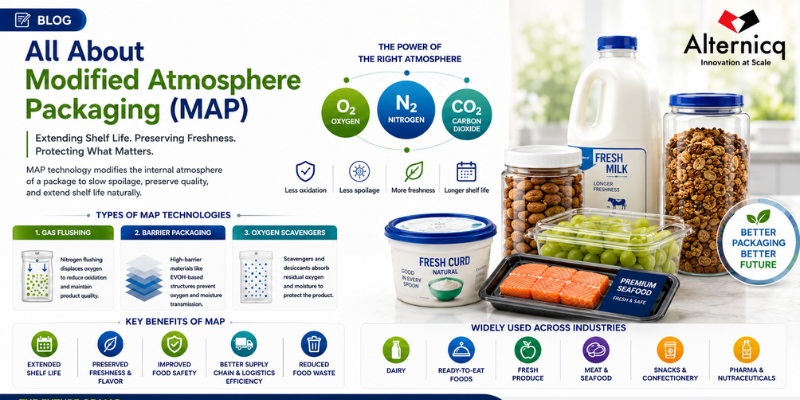
    Modified Atmosphere Packaging (MAP) is a food packaging technology that modifies the internal atmosphere of a package to slow down spoilage and extend product shelf life. 

    MAP works by controlling gases such as: 

    • Oxygen (O₂)  
    • Nitrogen (N₂)  
    • Carbon Dioxide (CO₂)  

    The technology reduces oxidation, inhibits microbial growth, and protects the flavor, texture, aroma, and appearance of food products. 

    MAP is widely used across industries including: 

    • Dairy packaging  
    • Ready-to-eat foods  
    • Snacks and confectionery  
    • Fresh produce  
    • Meat and seafood  
    • Beverages  
    • Pharmaceutical and nutraceutical packaging  

    Why Shelf Life Matters in Food Packaging 

    Shelf life refers to the duration during which a food or beverage product remains safe, stable, and acceptable for human consumption. 

    Several factors influence shelf life, including: 

    • Raw material quality  
    • Product formulation  
    • Packaging material selection  
    • Processing methods  
    • Storage conditions  
    • Exposure to oxygen and moisture  
    • Temperature fluctuations  

    Oxygen and heat are among the biggest contributors to food degradation. They accelerate: 

    • Oxidation  
    • Flavor loss  
    • Discoloration  
    • Nutrient degradation  
    • Microbial growth  
    • Texture changes  

    While thermal processing technologies are commonly used to extend shelf life, they may not be suitable for every product category. This has increased the adoption of non-thermal preservation methods such as Modified Atmosphere Packaging and active packaging systems. 

    Types of Modified Atmosphere Packaging Technologies 

    1. Gas Flushing Technology 

    Gas flushing is one of the most widely used active MAP technologies in food packaging. 

    In this process, gases such as nitrogen are introduced into the package before sealing to displace oxygen from the pack environment. 

    Gas flushing helps achieve three major objectives: 

    • Delays oxidation by reducing oxygen levels  
    • Slows the growth of aerobic microorganisms  
    • Maintains package shape and structural conformity  

    Nitrogen flushing is especially effective for products sensitive to oxygen exposure, including snacks, coffee, dairy products, and powdered food ingredients. 

    2. Barrier Packaging Materials 

    Barrier packaging is a passive MAP approach that uses high-performance packaging materials to limit the transmission of oxygen and moisture. 

    Common barrier materials include: 

    • Low-Density Polyethylene (LDPE)  
    • High-Density Polyethylene (HDPE)  
    • Polypropylene (PP)  
    • Multi-layer barrier structures  

    Many oxygen-sensitive products such as sauces, dairy products, beverages, and nutraceuticals use advanced multi-layer packaging structures. 

    A key component in high-barrier packaging is EVOH (Ethylene Vinyl Alcohol), a high-performance thermoplastic copolymer known for its exceptional gas barrier properties. 

    EVOH-based packaging offers: 

    • Superior oxygen barrier performance  
    • Extended shelf life  
    • Improved aroma retention  
    • Enhanced product freshness  
    • Reduced food waste  

    Barrier packaging technologies are increasingly critical in sustainable food packaging because they help improve product longevity and supply chain efficiency. 

    3. Oxygen Scavengers and Desiccant Systems 

    Another important MAP solution involves the use of oxygen scavengers and desiccant packs inside packaging. 

    These systems actively absorb oxygen and moisture from the package environment to prevent spoilage. 

    Common scavenger components include: 

    • Iron powder  
    • Ascorbic acid  
    • Activated carbon  

    These ingredients react with ambient oxygen and moisture, helping protect sensitive products from degradation. 

    Oxygen scavengers are commonly used in: 

    • Pharmaceutical packaging  
    • Nutraceutical packaging  
    • Dry foods  
    • Powdered products  
    • Moisture-sensitive products  

    How Modified Atmosphere Packaging Protects Food 

    MAP technologies primarily protect food by minimizing oxygen exposure inside the package. 

    Reduced oxygen levels help: 

    • Slow oxidation  
    • Preserve freshness  
    • Prevent discoloration  
    • Maintain texture and flavor  
    • Reduce microbial activity  
    • Extend shelf stability  

    This ensures food products remain visually appealing and safe for consumption over longer periods. 

    Modified Atmosphere Packaging also supports: 

    • Reduced food wastage  
    • Improved transportation efficiency  
    • Longer distribution cycles  
    • Better retail shelf performance  
    • Enhanced consumer convenience  

    The Growing Importance of MAP in Modern Supply Chains 

    The importance of Modified Atmosphere Packaging increased significantly during the COVID-19 pandemic, when consumers shifted toward packaged foods with extended shelf life and higher safety assurance. 

    Today, evolving consumer behavior, e-commerce grocery growth, global supply chains, and sustainability goals continue to accelerate demand for advanced food packaging technologies. 

    Brands are increasingly investing in: 

    • Sustainable barrier packaging  
    • Recyclable food packaging  
    • High-performance mono-material solutions  
    • Active packaging systems  
    • Circular packaging innovations  

    The Future of Modified Atmosphere Packaging 

    The future of MAP lies at the intersection of sustainability, smart packaging, and advanced material science. 

    Emerging trends include: 

    • Recyclable barrier packaging  
    • Mono-material MAP structures  
    • PCR-integrated food packaging  
    • Intelligent freshness indicators  
    • AI-driven shelf life optimization  
    • Sustainable active packaging technologies  

    As food brands continue to prioritize sustainability and product performance, Modified Atmosphere Packaging will remain a key enabler of next-generation packaging innovation. 

    Frequently Asked Questions 

    What is Modified Atmosphere Packaging (MAP)? 

    Modified Atmosphere Packaging is a packaging technology that alters the internal gas composition of a package to slow spoilage and extend shelf life. 

    What gases are used in MAP packaging? 

    The most commonly used gases are nitrogen (N₂), carbon dioxide (CO₂), and oxygen (O₂), depending on the product requirements. 

    What are the benefits of MAP packaging? 

    MAP packaging helps: 

    • Extend shelf life  
    • Maintain freshness  
    • Reduce oxidation  
    • Improve food safety  
    • Minimize food waste  
    • Preserve flavor and texture  

    Which industries use MAP packaging? 

    Industries such as food and beverage, dairy, pharmaceuticals, nutraceuticals, personal care, and healthcare widely use MAP technologies. 

    Does Alternicq offer advanced packaging solutions for shelf life enhancement? 

    Yes. Alternicq Limited develops innovative rigid plastic packaging solutions designed to enhance product protection, sustainability, and packaging performance across industries.

  • Lightweighting for Stronger Sustainability Impact 

    Lightweighting for Stronger Sustainability Impact 

    Sustainable packaging today goes beyond reducing material usage. It focuses on creating high-performance packaging solutions that balance product protection, operational efficiency, recyclability, and carbon footprint reduction across the entire packaging lifecycle. Modern packaging innovation increasingly relies on Life Cycle Assessment (LCA), Life Cycle Inventory (LCI), circular economy principles, and material optimization to deliver measurable sustainability outcomes. 

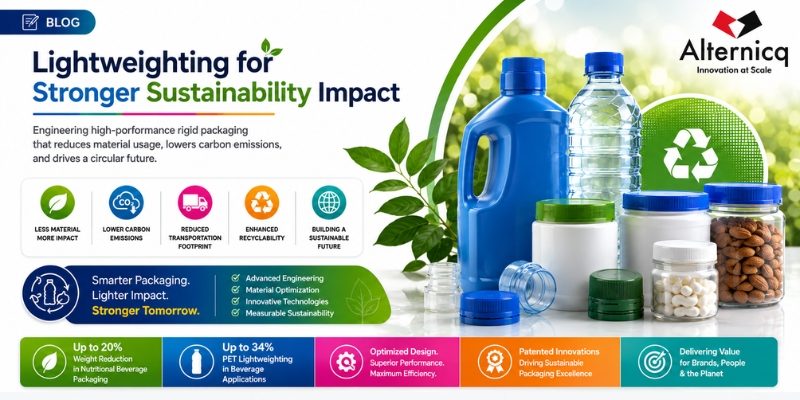
    Lightweighting has emerged as one of the most impactful sustainable packaging strategies in the rigid plastic packaging industry. It involves redesigning packaging structures to reduce overall material consumption while maintaining product integrity, shelf performance, transportation durability, and consumer convenience. 

    By reducing resin usage, lightweight packaging helps brands lower carbon emissions, optimize logistics costs, improve material efficiency, and enhance recyclability without compromising functionality or aesthetics. 

    At Alternicq Limited, lightweighting is integrated into packaging innovation through advanced engineering, material science, structural redesign, and sustainable manufacturing practices. 

    What is Lightweighting in Plastic Packaging? 

    Lightweighting refers to the process of reducing the weight of plastic packaging through intelligent structural engineering, optimized material distribution, and advanced manufacturing technologies. 

    This can be achieved through: 

    • Thin-wall packaging design  
    • Neck and closure optimization  
    • Material substitution and density reduction  
    • Structural rib enhancements  
    • Foaming technologies  
    • Advanced resin engineering  
    • Design-for-recyclability innovations  

    The objective is to maximize packaging efficiency while minimizing raw material consumption and environmental impact. 

    Foaming Technology: Advancing Sustainable Packaging 

    One of the recent innovations in lightweight plastic packaging is foaming technology. 

    Foaming is achieved through the controlled infusion of inert gases such as CO₂ or nitrogen (N₂) into suitable polyolefin layers during the manufacturing process. This creates a microcellular structure within the plastic, reducing material density while retaining mechanical strength and functional performance. 

    Benefits of foamed lightweight packaging include: 

    • Lower plastic consumption  
    • Reduced packaging weight  
    • Improved sustainability metrics  
    • Lower transportation emissions  
    • Enhanced material efficiency  
    • Reduced overall carbon footprint  

    This technology enables brands to achieve sustainability goals while maintaining packaging durability and consumer experience. 

    Lightweighting Innovations at Alternicq 

    At Alternicq Limited, lightweighting is a core part of sustainable packaging innovation across FMCG, beverage, dairy, personal care, and healthcare packaging solutions. 

    Through continuous packaging redesign and engineering optimization, we have achieved: 

    • Up to 20% weight reduction for malt-based nutritional beverage packaging  
    • Up to 34% PET lightweighting for select beverage packaging applications  
    • Reduced wall thickness without compromising structural performance  
    • Advanced super short neck jar and cap innovations  
    • Enhanced closure optimization technologies  
    • Development of Neck Support Ring (NSR) innovations for bottle and cap weight reduction  
    • Integration of tamper-evident lightweight packaging features  

    Our patented and patent-pending packaging technologies are helping global and Indian brands reduce material usage while improving sustainability performance and operational efficiency. 

    Key Techniques Used in PET Lightweighting 

    Lightweighting in PET packaging requires a balance between design innovation, manufacturability, filling-line compatibility, and packaging performance. 

    Some of the most effective PET lightweighting techniques include: 

    1. Technical Rib Integration 

    Strategically placed ribs improve structural rigidity and top-load performance while allowing lower wall thicknesses. 

    2. Neck Finish Optimization 

    Reducing material usage in bottle necks and closures where internal pressure requirements are minimal helps lower overall resin consumption. 

    3. Thin-Wall Packaging Design 

    Optimized wall thickness distribution enables significant material reduction while maintaining functionality and shelf stability. 

    4. Shape Redesign and Structural Engineering 

    Container geometry plays a critical role in achieving lightweighting without compromising strength or consumer usability. 

    5. High Intrinsic Viscosity (I.V.) Resin Utilization 

    Using higher I.V. resins where feasible improves mechanical performance and allows material reduction. 

    Operational Considerations in Lightweight Packaging 

    Successful lightweight packaging development must also account for downstream manufacturing and filling operations. 

    Filling Line Compatibility 

    Packaging designed for jet-stream air systems and neck-handling conveyor systems requires specialized structural support below the neck finish to ensure smooth line performance. 

    Labeling Efficiency 

    Thin-wall bottles become more flexible before filling, which can affect labeling accuracy. For optimal performance, lightweight PET bottles are often labeled after the filling process. 

    Transportation and Supply Chain Stability 

    Packaging must maintain stackability, compression resistance, and transportation durability despite reduced material usage. 

    Why Lightweighting Matters for Brands 

    Lightweight packaging delivers both sustainability and business advantages. 

    Sustainability Benefits 

    • Lower carbon emissions  
    • Reduced virgin plastic consumption  
    • Improved recyclability  
    • Reduced transportation footprint  
    • Better resource efficiency  

    Business Benefits 

    • Lower packaging costs  
    • Improved logistics efficiency  
    • Reduced resin dependency  
    • Enhanced ESG performance  
    • Stronger sustainability positioning for consumers and regulators  

    As brands increasingly focus on circular economy goals and sustainable packaging commitments, lightweighting is becoming a critical innovation driver across industries. 

    Frequently Asked Questions 

    How is PET lightweighting achieved? 

    PET lightweighting is achieved through packaging redesign, thin-wall engineering, neck optimization, structural rib enhancements, and advanced resin technologies that reduce overall packaging weight while maintaining functionality and performance. 

    Does lightweighting compromise packaging strength? 

    No. Modern lightweight packaging uses advanced engineering techniques to maintain structural integrity, top-load performance, durability, and filling-line compatibility even with reduced material usage. 

    What industries benefit from lightweight packaging? 

    Industries including FMCG, beverages, dairy, pharmaceuticals, home care, personal care, and food packaging benefit significantly from lightweight packaging innovations. 

    Is Alternicq working on sustainable lightweight packaging solutions? 

    Yes. Alternicq Limited continues to develop advanced lightweight packaging technologies through structural innovation, material optimization, and sustainable packaging engineering across multiple product categories. 

    What is the future of lightweight packaging? 

    The future of lightweight packaging lies in combining recyclable materials, PCR integration, advanced barrier technologies, AI-driven packaging design optimization, and circular economy principles to deliver high-performance sustainable packaging solutions at scale.