Blog

  • All About Modified Atmosphere Packaging (MAP)

    All About Modified Atmosphere Packaging (MAP)

    In today’s food and beverage industry, shelf life extension is no longer just about preservation — it is about maintaining freshness, product integrity, safety, sustainability, and consumer trust across increasingly complex supply chains. 

    Modified Atmosphere Packaging (MAP) has emerged as one of the most effective packaging technologies for extending shelf life while preserving the sensory and nutritional quality of food products. By controlling the gaseous environment inside a package, MAP helps reduce spoilage, minimize oxidation, and maintain freshness for longer durations. 

    At Alternicq Limited, we continuously explore advanced food packaging technologies that help brands improve product protection, operational efficiency, and sustainability outcomes. 

    What is Modified Atmosphere Packaging (MAP)? 

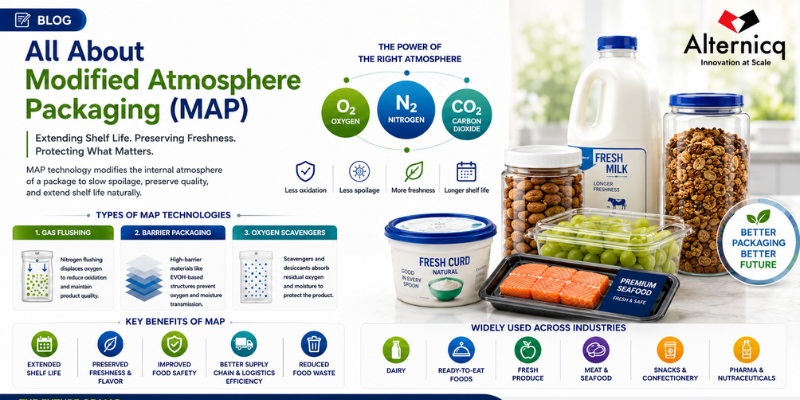
    Modified Atmosphere Packaging (MAP) is a food packaging technology that modifies the internal atmosphere of a package to slow down spoilage and extend product shelf life. 

    MAP works by controlling gases such as: 

    • Oxygen (O₂)  
    • Nitrogen (N₂)  
    • Carbon Dioxide (CO₂)  

    The technology reduces oxidation, inhibits microbial growth, and protects the flavor, texture, aroma, and appearance of food products. 

    MAP is widely used across industries including: 

    • Dairy packaging  
    • Ready-to-eat foods  
    • Snacks and confectionery  
    • Fresh produce  
    • Meat and seafood  
    • Beverages  
    • Pharmaceutical and nutraceutical packaging  

    Why Shelf Life Matters in Food Packaging 

    Shelf life refers to the duration during which a food or beverage product remains safe, stable, and acceptable for human consumption. 

    Several factors influence shelf life, including: 

    • Raw material quality  
    • Product formulation  
    • Packaging material selection  
    • Processing methods  
    • Storage conditions  
    • Exposure to oxygen and moisture  
    • Temperature fluctuations  

    Oxygen and heat are among the biggest contributors to food degradation. They accelerate: 

    • Oxidation  
    • Flavor loss  
    • Discoloration  
    • Nutrient degradation  
    • Microbial growth  
    • Texture changes  

    While thermal processing technologies are commonly used to extend shelf life, they may not be suitable for every product category. This has increased the adoption of non-thermal preservation methods such as Modified Atmosphere Packaging and active packaging systems. 

    Types of Modified Atmosphere Packaging Technologies 

    1. Gas Flushing Technology 

    Gas flushing is one of the most widely used active MAP technologies in food packaging. 

    In this process, gases such as nitrogen are introduced into the package before sealing to displace oxygen from the pack environment. 

    Gas flushing helps achieve three major objectives: 

    • Delays oxidation by reducing oxygen levels  
    • Slows the growth of aerobic microorganisms  
    • Maintains package shape and structural conformity  

    Nitrogen flushing is especially effective for products sensitive to oxygen exposure, including snacks, coffee, dairy products, and powdered food ingredients. 

    2. Barrier Packaging Materials 

    Barrier packaging is a passive MAP approach that uses high-performance packaging materials to limit the transmission of oxygen and moisture. 

    Common barrier materials include: 

    • Low-Density Polyethylene (LDPE)  
    • High-Density Polyethylene (HDPE)  
    • Polypropylene (PP)  
    • Multi-layer barrier structures  

    Many oxygen-sensitive products such as sauces, dairy products, beverages, and nutraceuticals use advanced multi-layer packaging structures. 

    A key component in high-barrier packaging is EVOH (Ethylene Vinyl Alcohol), a high-performance thermoplastic copolymer known for its exceptional gas barrier properties. 

    EVOH-based packaging offers: 

    • Superior oxygen barrier performance  
    • Extended shelf life  
    • Improved aroma retention  
    • Enhanced product freshness  
    • Reduced food waste  

    Barrier packaging technologies are increasingly critical in sustainable food packaging because they help improve product longevity and supply chain efficiency. 

    3. Oxygen Scavengers and Desiccant Systems 

    Another important MAP solution involves the use of oxygen scavengers and desiccant packs inside packaging. 

    These systems actively absorb oxygen and moisture from the package environment to prevent spoilage. 

    Common scavenger components include: 

    • Iron powder  
    • Ascorbic acid  
    • Activated carbon  

    These ingredients react with ambient oxygen and moisture, helping protect sensitive products from degradation. 

    Oxygen scavengers are commonly used in: 

    • Pharmaceutical packaging  
    • Nutraceutical packaging  
    • Dry foods  
    • Powdered products  
    • Moisture-sensitive products  

    How Modified Atmosphere Packaging Protects Food 

    MAP technologies primarily protect food by minimizing oxygen exposure inside the package. 

    Reduced oxygen levels help: 

    • Slow oxidation  
    • Preserve freshness  
    • Prevent discoloration  
    • Maintain texture and flavor  
    • Reduce microbial activity  
    • Extend shelf stability  

    This ensures food products remain visually appealing and safe for consumption over longer periods. 

    Modified Atmosphere Packaging also supports: 

    • Reduced food wastage  
    • Improved transportation efficiency  
    • Longer distribution cycles  
    • Better retail shelf performance  
    • Enhanced consumer convenience  

    The Growing Importance of MAP in Modern Supply Chains 

    The importance of Modified Atmosphere Packaging increased significantly during the COVID-19 pandemic, when consumers shifted toward packaged foods with extended shelf life and higher safety assurance. 

    Today, evolving consumer behavior, e-commerce grocery growth, global supply chains, and sustainability goals continue to accelerate demand for advanced food packaging technologies. 

    Brands are increasingly investing in: 

    • Sustainable barrier packaging  
    • Recyclable food packaging  
    • High-performance mono-material solutions  
    • Active packaging systems  
    • Circular packaging innovations  

    The Future of Modified Atmosphere Packaging 

    The future of MAP lies at the intersection of sustainability, smart packaging, and advanced material science. 

    Emerging trends include: 

    • Recyclable barrier packaging  
    • Mono-material MAP structures  
    • PCR-integrated food packaging  
    • Intelligent freshness indicators  
    • AI-driven shelf life optimization  
    • Sustainable active packaging technologies  

    As food brands continue to prioritize sustainability and product performance, Modified Atmosphere Packaging will remain a key enabler of next-generation packaging innovation. 

    Frequently Asked Questions 

    What is Modified Atmosphere Packaging (MAP)? 

    Modified Atmosphere Packaging is a packaging technology that alters the internal gas composition of a package to slow spoilage and extend shelf life. 

    What gases are used in MAP packaging? 

    The most commonly used gases are nitrogen (N₂), carbon dioxide (CO₂), and oxygen (O₂), depending on the product requirements. 

    What are the benefits of MAP packaging? 

    MAP packaging helps: 

    • Extend shelf life  
    • Maintain freshness  
    • Reduce oxidation  
    • Improve food safety  
    • Minimize food waste  
    • Preserve flavor and texture  

    Which industries use MAP packaging? 

    Industries such as food and beverage, dairy, pharmaceuticals, nutraceuticals, personal care, and healthcare widely use MAP technologies. 

    Does Alternicq offer advanced packaging solutions for shelf life enhancement? 

    Yes. Alternicq Limited develops innovative rigid plastic packaging solutions designed to enhance product protection, sustainability, and packaging performance across industries.
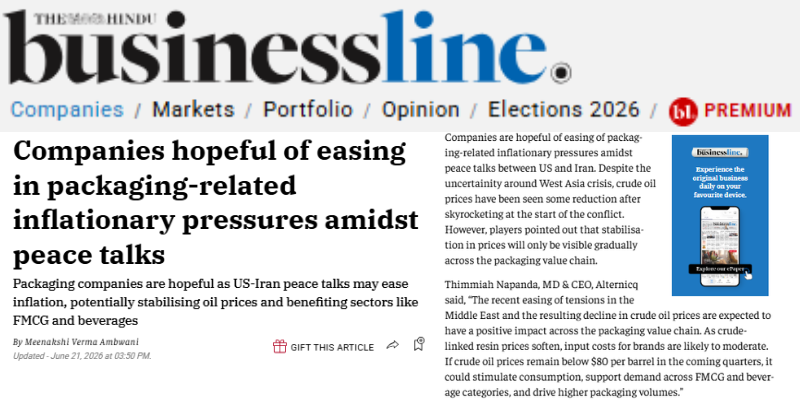
  • Peace talks may reduce packaging inflation pressures for companies.

    Peace talks may reduce packaging inflation pressures for companies.

    Meenakshi Verma Ambwani

    US-Iran War

    21st June 2026

    The Hindu Business Line

    Thimmiah Napanda, Managing Director & CEO, Alternicq, highlighted that easing geopolitical tensions and softer crude oil prices are expected to bring relief across the packaging value chain. Lower crude prices could gradually reduce resin costs, helping moderate packaging input costs for brands. While the impact may take time to flow through existing inventories, sustained crude prices below $80 per barrel could support consumption across FMCG and beverage sectors. This, in turn, is expected to drive higher packaging demand and volume growth. Alternicq remains optimistic about the positive outlook for the industry.

    Companies hopeful of easing in packaging-related inflationary pressures amidst peace talks

  • FMCG costs ease; consumers await price reductions

    FMCG costs ease; consumers await price reductions

    Sowmya Ramasubramanium

    US-Iran War

    17th June 2026

    Mint

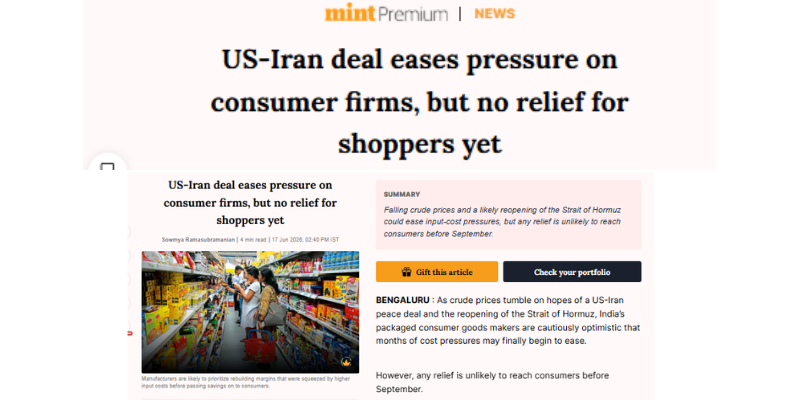
    Thimmiah Napanda, Managing Director & CEO, Alternicq, noted that the company and its customers prioritised supply security during the recent period of uncertainty, leading to inventory build-up at elevated raw material prices. As crude prices soften, the benefits are expected to flow gradually through the value chain. Existing inventories and contractual commitments are likely to delay immediate cost reductions. Companies are expected to first restore margins before passing on benefits to the market. Nevertheless, improved crude price stability is expected to support a healthier packaging ecosystem and demand outlook.

    US-Iran deal eases pressure on consumer firms, but no relief for shoppers yet (Print)

  • FMCG costs ease; consumers await price reductions.

    FMCG costs ease; consumers await price reductions.

    Sowmya Ramasubramanium

    US-Iran War

    17th June 2026

    Mint

    Thimmiah Napanda, Managing Director & CEO, Alternicq, said the company and its customers focused on securing supplies amid uncertainty in raw material availability, leading to inventory build-up at elevated prices. As crude prices ease, the benefits are expected to flow gradually through the packaging value chain. Existing inventories will delay immediate cost relief, and companies are likely to prioritise rebuilding margins before passing on benefits to consumers. Nevertheless, improved geopolitical stability and softer crude prices are expected to support a healthier demand environment for the packaging industry.

    US-Iran deal eases pressure on consumer firms, but no relief for shoppers yet

  • Packaging must prioritize resilience beyond cost efficiency.

    Packaging must prioritize resilience beyond cost efficiency.

    Oped Editor

    US-Iran War

    8th May 2026

    Industrial Products Finder

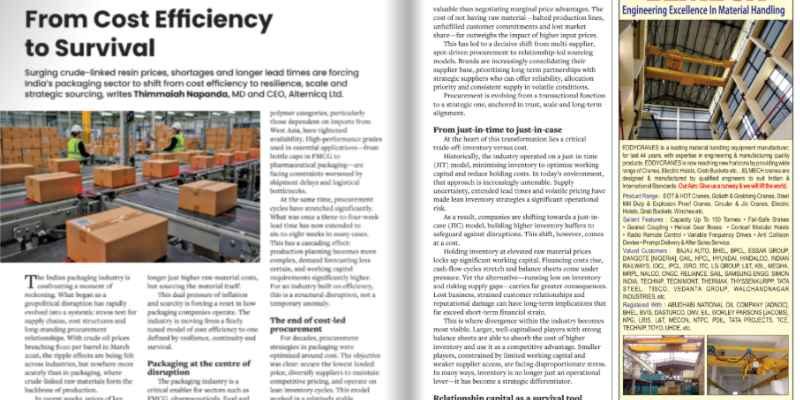
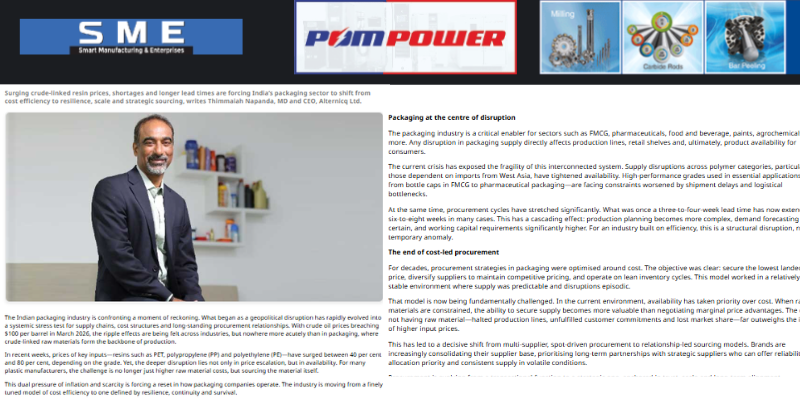
    In an article for Packaging South Asia, Thimmiah Napanda, Managing Director & CEO, Alternicq, highlighted how geopolitical disruptions and volatile crude-linked resin prices are reshaping India’s packaging sector. He noted that companies are moving beyond cost efficiency towards resilience, supply security and strategic sourcing. Inventory management and long-term supplier partnerships have become critical to ensuring business continuity. As uncertainty persists, resilience—not just cost optimisation—is emerging as the new competitive advantage.

    May 2026

  • Packaging strategy shifts from efficiency to resilience.

    Packaging strategy shifts from efficiency to resilience.

    Oped Editor

    US-Iran War

    8th May 2026

    Industrial Products Finder

    Thimmiah Napanda, Managing Director & CEO, Alternicq, highlighted that the current volatility in crude-linked resin prices is driving a structural shift in the packaging industry. He noted that companies are moving beyond cost efficiency towards resilience, strategic sourcing and stronger supplier partnerships. As supply security takes precedence, inventory management and long-term relationships are emerging as key competitive advantages. In this new environment, resilience and continuity are becoming as important as cost optimisation.

    From Cost Efficiency to Survival

  • Iran conflict significantly increases Alternicq’s raw material costs.

    Iran conflict significantly increases Alternicq’s raw material costs.

    Desk

    US-Iran War

    21st April 2026

    The Economic Times

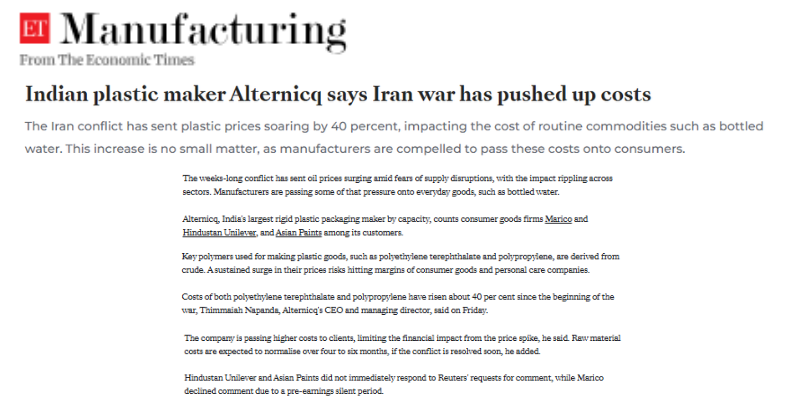
    Thimmiah Napanda, Managing Director & CEO, Alternicq, highlighted that the Iran conflict triggered a sharp increase in crude-linked resin prices, with PET and polypropylene costs rising by nearly 40%. Despite the volatility, Alternicq leveraged its long-standing relationships with domestic refiners to ensure supply continuity and minimise disruptions. The company worked closely with customers to manage the cost impact through calibrated price pass-throughs. Napanda noted that if geopolitical tensions ease, raw material prices could normalise over the next four to six months, bringing stability to the packaging value chain.

    Indian plastic maker Alternicq says Iran war has pushed up costs

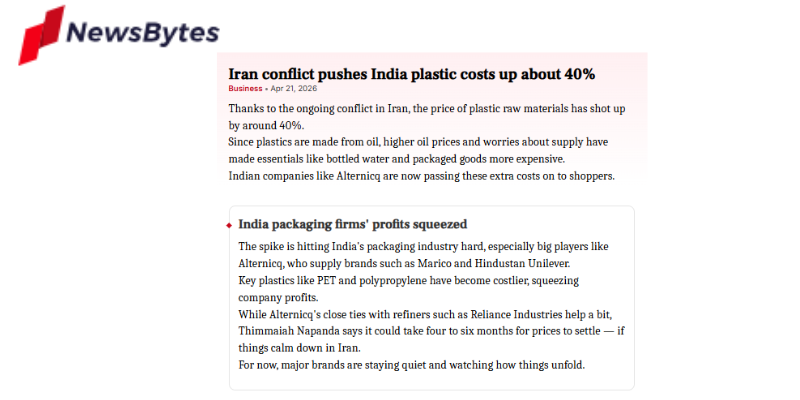
  • Iran conflict raises India’s plastic costs by nearly 40%

    Iran conflict raises India’s plastic costs by nearly 40%

    Desk

    US-Iran War

    21st April 2026

    News Bytes

    Thimmiah Napanda, Managing Director & CEO, Alternicq, highlighted that the Iran conflict led to a sharp increase in crude-linked resin prices, with PET and polypropylene costs rising by nearly 40%. Despite the volatility, Alternicq leveraged strong relationships with domestic refiners to ensure supply continuity and minimise disruptions. The company worked closely with customers to manage the impact through calibrated price pass-throughs. Napanda noted that raw material prices could normalise within four to six months, subject to easing geopolitical tensions and stabilisation of global supply chains.

    Iran conflict pushes India plastic costs up about 40%

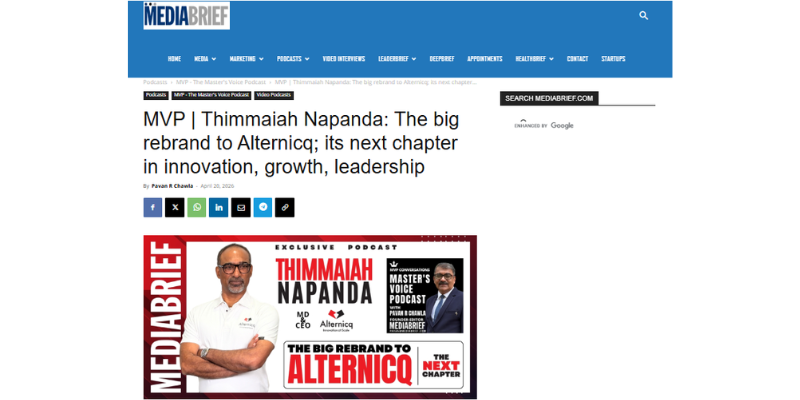
  • Thimmaiah discusses Alternicq’s innovation-led rebranding and growth vision

    Thimmaiah discusses Alternicq’s innovation-led rebranding and growth vision

    Pavan R Chawla

    Rebranding

    20th April 2026

    Media Brief

    Thimmiah Napanda, Managing Director & CEO, Alternicq, shared his vision for the company’s transformation from Manjushree Technopack to Alternicq, marking the beginning of a new chapter focused on innovation at scale. He emphasised that the rebranding reflects a broader strategic shift towards becoming an innovation-led, one-stop rigid plastic packaging solutions partner. Napanda highlighted the importance of circularity, customer-centric design, talent development and operational excellence in shaping the future of the packaging industry. Under his leadership, Alternicq is positioning itself to drive sustainable growth and support India’s evolving manufacturing ecosystem.

    MVP | Thimmaiah Napanda: The big rebrand to Alternicq; its next chapter in innovation, growth, leadership

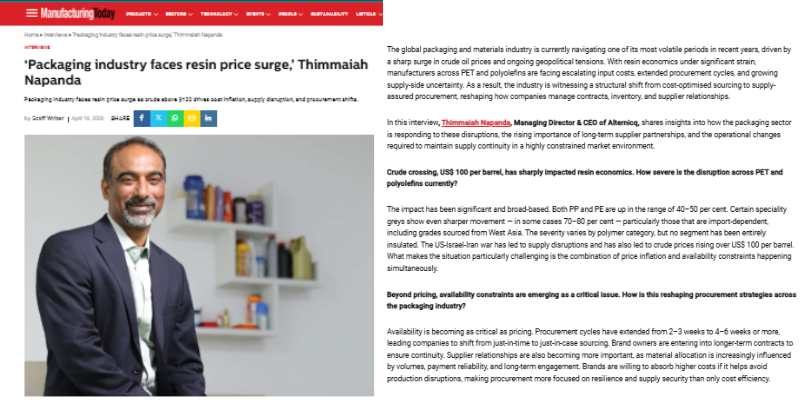
  • Resin price surge challenges packaging industry’s profitability and operations.

    Resin price surge challenges packaging industry’s profitability and operations.

    Sujata Vishnuraj

    US-Iran War

    16th April 2026

    Manufacturing

    Thimmiah Napanda, Managing Director & CEO, Alternicq, highlighted that the sharp rise in crude prices and resin costs has triggered a structural shift in the packaging industry from cost-led sourcing to supply-assured procurement. He emphasised that long-term supplier relationships, inventory buffers and collaborative customer partnerships are becoming critical to ensuring continuity in a volatile environment. Alternicq has prioritised supply security and transparent cost pass-throughs while leveraging its scale and strategic supplier network. Napanda also sees the disruption accelerating industry consolidation and driving greater adoption of circular packaging solutions through initiatives such as Project Earth.

    ‘Packaging industry faces resin price surge,’ Thimmaiah Napanda

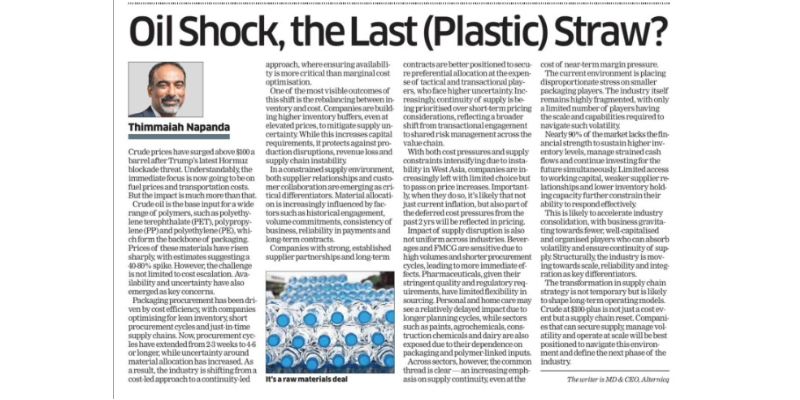
  • Oil shock intensifies pressure on plastic packaging industry.

    Oil shock intensifies pressure on plastic packaging industry.

    Oped Editor

    US-Iran War

    14th April 2026

    The Economic Times

    Thimmiah Napanda, Managing Director & CEO, Alternicq, highlighted that crude prices above $100 per barrel have triggered a structural reset across the packaging value chain. He noted that the industry is shifting from cost-led procurement to continuity-led supply strategies, with inventory buffers and long-term supplier relationships becoming critical. Napanda emphasized that scale, financial strength and strategic partnerships are emerging as key differentiators amid volatility. He also expects the current environment to accelerate consolidation, favouring organised players capable of ensuring supply continuity and managing uncertainty effectively.

    Oil Shock, the Last (Plastic) Straw? (Print)